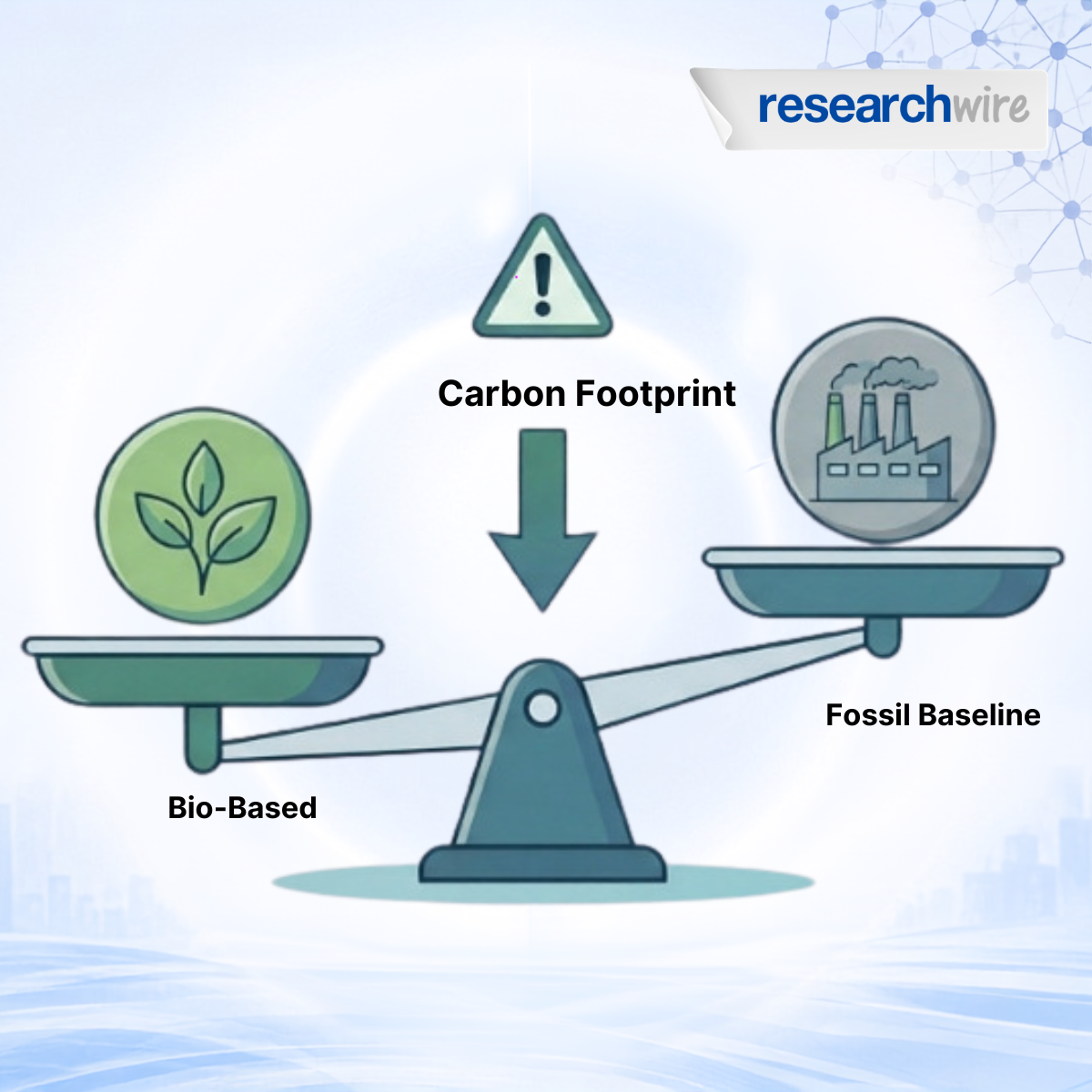
Comparative Life Cycle Assessment: Fatty Alcohol Production Routes
04 Aug, 2026
5 min
Client Overview and Key Challenges
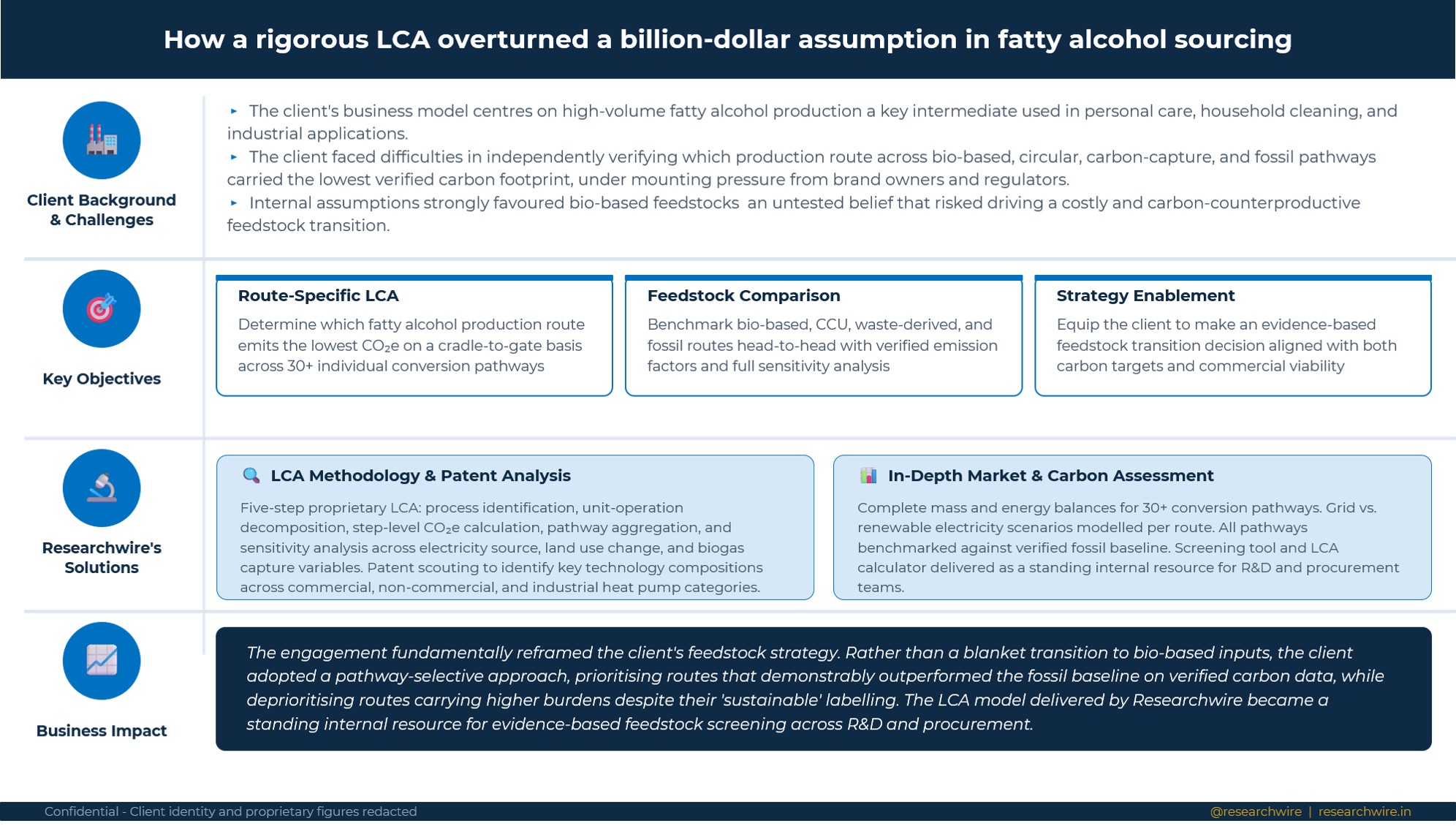
▸ A major global speciality chemicals and surfactants company’s business model revolved around producing high-volume fatty alcohol intermediates used across personal care, household cleaning, and industrial applications.
▸ The client faced mounting pressure from downstream brand owners and regulators to demonstrate lower-carbon supply chains, requiring a verified determination of which production route across bio-based, circular, carbon utilisation, and fossil-derived pathways carried the lowest carbon footprint.
▸ Internally, the client held strong assumptions favouring bio-based feedstocks over fossil-derived pathways, consistent with prevailing industry sustainability narratives. Without rigorous evidence, this assumption risked driving a costly and carbon-counterproductive feedstock transition.
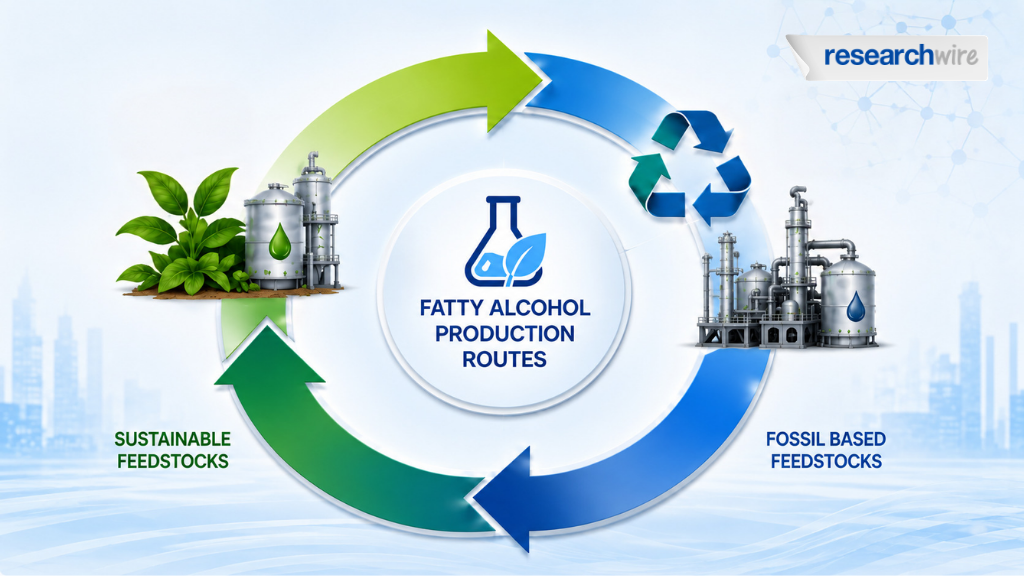
Primary Objective
▸ Partnering with Researchwire, the goal was to conduct a route-specific Life Cycle Assessment (LCA) to objectively determine which fatty alcohol production pathway emits the lowest CO₂e on a cradle-to-gate basis.
▸ With a rigorous, independently calculated comparison in hand, the client aimed to make an evidence-based feedstock strategy decision prioritising routes with genuinely lower carbon burdens and identifying new pathway opportunities aligned with both sustainability targets and commercial viability.
Our Research Approach and Solutions
We developed a five-step proprietary LCA methodology designed to handle the complexity of multi-pathway, multi-feedstock comparisons:
- Process Identification & Decomposition: Mapped each route’s full conversion chain from raw feedstock to finished fatty alcohol, filtering by Technology Readiness Level (TRL ≥ 3). Each pathway was broken into discrete unit operations with all material inputs, energy consumption, and waste streams catalogued at each step.
- Step-Level LCA Calculation: Calculated CO₂e emissions at each unit operation using verified emission factors from peer-reviewed literature and established LCA databases. Where published LCA values were unavailable, emissions were calculated from first principles using mass and energy balances.
- Pathway-Level Aggregation & Scenario Modelling: Summed step-level emissions to produce total cradle-to-gate GWP values per pathway, modelled under both grid electricity and 100% renewable electricity scenarios.
- Comparative Ranking & Sensitivity Analysis: Ranked all pathways and tested sensitivity to key variables like electricity source, land use change assumptions, biogas capture rates, and catalyst lifetimes.
Key outcomes from the analysis
- The conventional fossil-based route delivered one of the lowest and most consistent carbon footprints across all pathways, significantly outperforming the commercially dominant bio-based route, but it is not a sustainable feedstock.
- Upstream agriculture, not conversion chemistry, drove the carbon burden of bio-based routes, primarily through land use change, fertiliser-related N₂O emissions, and uncaptured methane from mill effluent.
- Select non-deforestation-linked bio-oils and waste polyethylene via pyrolysis proved genuinely competitive with fossil baselines.
- Captured CO₂ (CCU) pathways showed the widest performance range from carbon-negative outcomes under ideal conditions to significantly worse than fossil under grid electricity. Energy source proved more impactful than feedstock source for CCU routes.
Results
| The engagement fundamentally reframed the client’s feedstock strategy. Rather than a blanket transition to bio-based inputs, the client adopted a pathway-selective approach prioritising routes that demonstrably outperformed the fossil baseline on verified carbon data, while deprioritising routes carrying higher burdens despite their ‘sustainable’ labelling. The LCA model and screening tool delivered by Researchwire became a standing internal resource for the client’s R&D and procurement teams, enabling rapid, evidence-based evaluation of all future feedstock options. |