In recent years, medical technology has undergone a quiet revolution that is giving people who have lived in darkness the ability to see again. Breakthroughs in bionic eye systems, retinal implants and direct brain–image interfaces have reshaped what we once thought was impossible in neuroprosthetics. What was once science fiction, capturing images with a tiny camera and transmitting them directly into the brain is now beginning to help blind individuals recognize objects, navigate environments and regain a sense of visual autonomy.
This transformation is not only reshaping patient lives but also opening up a completely new frontier for intellectual property (IP) and medical innovation. Much like how machine learning revolutionized chemistry, bionic-vision technologies are pushing the boundaries of how biological systems, electronics, algorithms, and human cognition intersect. As these devices evolve from early grayscale perception to more advanced visual reconstruction the patent landscape around neurovisual devices is becoming more complex and more important than ever.
A New Era of Sight: How Bionic Eyes Work
Bionic eye technology has progressed dramatically in the last decade. Instead of traditional corrective methods, these systems bypass damaged retinal cells and deliver visual information directly to the optic nerve or even the visual cortex itself.
Most modern systems follow a similar architecture:
-
A miniature external camera
Often mounted on glasses, the camera captures real-time visual scenes.
-
A processing unit
This unit translates visual scenes into simplified electrical patterns the brain can interpret.
-
An implant (retinal, optic nerve, or cortical)
Electrodes stimulate the appropriate neural pathways, creating perceptions of shapes, movement, or light.
-
Real-time neural adaptation
Over time, users learn to interpret these signals as meaningful images, similar to how one adapts to a new sensory language.
The result
Not full, natural sight but functional vision that lets people perceive objects, identify edges, detect movement, and navigate spaces they couldn’t before.
For many, this is nothing short of life changing.
From Light Perception to Face Recognition
Early visual prosthetics produced only light flashes, but today’s systems can help users identify:
- Doors, furniture, and obstacles
- The outline of a person
- Basic facial differences
- High-contrast signs or objects
- Movement patterns in their surroundings
Some cortical implants send visual data straight to the brain, bypassing the eyes entirely. This is especially transformative for individuals with diseases where the retina cannot be repaired.
As neural electronics integration improves, researchers hope to restore increasingly detailed images, potentially unlocking color perception and true face recognition in the future.
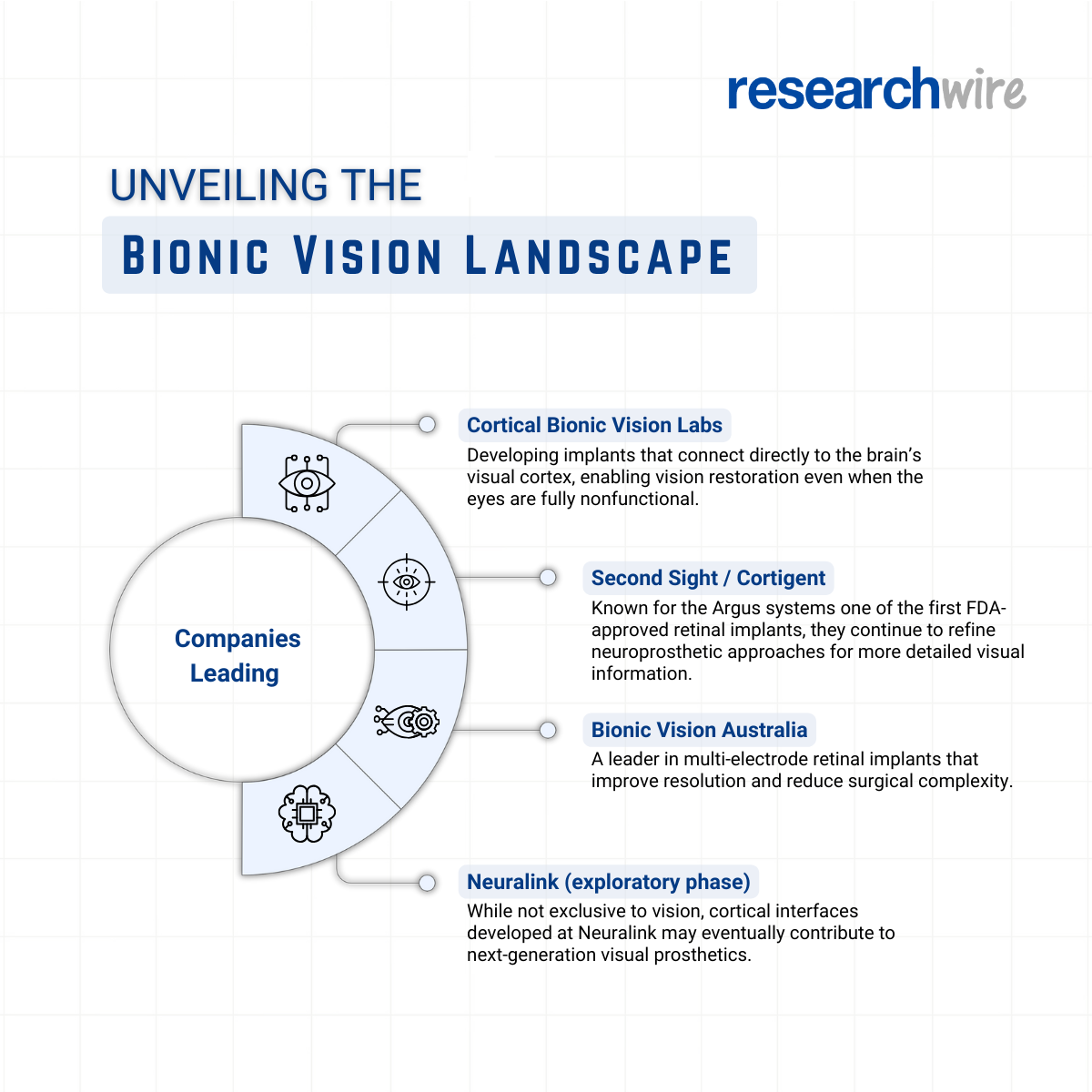
Companies Leading the Bionic Vision Revolution
Several organizations are accelerating advances in artificial sight, each contributing a different piece to the puzzle.
Researchwire’s Role in Supporting Innovation
As these technologies mature, Researchwire plays a key role in helping startups, research institutions, and med-tech innovators protect breakthroughs through:
- Patent drafting for neuroprosthetic devices
- Navigating cross-disciplinary IP (electronics, neurology, AI, imaging)
- Managing global patent filings
- Ensuring data and algorithm protection where applicable
Bionic vision is not just a medical breakthrough it’s an IP frontier.
The IP Challenges Behind Artificial Vision
While the medical promise is enormous, the patenting pathway for bionic eye systems is uniquely complex. These inventions often combine:
- Neuroscience
- AI-based image processing
- Signal-mapping algorithms
- Biocompatible materials
- Implantable electronics
- Machine learning–based visual reconstruction
Patent practitioners must clearly differentiate between:
- The hardware invention
Implant designs, electrode arrays, power systems, and microelectronics.
- The software algorithms
Signal translation, neural-mapping, adaptive stimulation, and image-compression methods.
- The medical method
The way visual data is delivered or interpreted by the patient’s brain.
Because courts often view algorithms as “abstract ideas,” innovators must frame their inventions as tangible, technical solutions such as a novel stimulation pattern that improves image clarity or a new electrode design that increases neural responsiveness.
Data as a Hidden Asset
Much like AI-driven chemistry, bionic eye development depends heavily on training data:
- Neural response maps
- Vision-simulation datasets
- Patient feedback logs
- Electrode stimulation profiles
While these datasets cannot be patented outright, they may function as valuable trade secrets, and Researchwire often consults on the best strategy to protect them.
Ethical and Regulatory Considerations
As visual prosthetics evolve into brain-connected digital systems, regulatory frameworks must catch up. Considerations include:
- Long-term implant safety
- Security of neural data
- Updates to software that interacts with the human brain
- Patient privacy in image-processing systems
Global patent offices are also refining their standards for inventions that combine medical devices, neuroscience, and machine learning.
The Future of Bionic Vision
We stand at the beginning not the end of the artificial-sight revolution. In the coming decade, we may see:
- Higher-resolution cortical implants
- Color-perception reconstruction
- Hybrid biological synthetic retinal systems
- AI models that translate vision into intuitive neural codes
- Fully wireless, low-profile implants
What began as flashes of light may grow into recognizable faces, detailed environments, and true visual independence.
As research accelerates, the interplay between neurotechnology, AI, and IP protection will determine how quickly these breakthroughs reach patients. Companies that understand both the scientific and legal landscapes especially with support from partners like Researchwire will shape the next era of human vision.