A standard essential patent is a patent that reads on technology a product must use to comply with a technical standard. Wi-Fi, 5G, video codecs, and wireless charging all sit on stacks of such patents. Owners who contribute technology into a standard usually commit to license it on fair, reasonable, and non-discriminatory (FRAND) terms. Implementers, in turn, need a way to know whether a declared patent is actually essential before they negotiate a royalty, design around a feature, or defend a suit.
Declaration is not proof. Standards bodies such as ETSI, IEEE, and ITU generally accept self-declarations. They do not run a claim-by-claim check of every patent against every clause of a specification. Studies of large cellular portfolios have repeatedly found that only a fraction of declared families are truly essential once someone maps the claims to the normative text. The practical tool for that mapping is the claim chart.
What an SEP claim chart does
An SEP claim chart is a structured comparison between the elements of a patent claim and the passages of a standard that are said to require those elements. It is the same discipline used in an infringement chart, with one important substitution: the “accused instrumentality” is not a teardown of a phone or a user manual. It is the specification itself.
A typical chart has three columns, sometimes four:
- The claim language, broken into limitations (preamble, then each step or structural element).
- The corresponding excerpt from the technical specification, cited by document number, version, section, and, where possible, the exact “shall” sentence.
- A short explanation of why that excerpt meets the limitation, including any claim-construction assumptions.
- Optionally, a status: met, partly met, or not met, plus notes on alternatives, optional features, or missing elements.
The legal test is necessity, not usefulness. A patent is essential when it is not possible, on technical grounds and taking normal technical practice into account, to implement the standard without practising the claim. If a compliant product can omit the feature and still conform, the patent is not essential to that requirement, even if the feature is popular or recommended.
How evaluators actually test essentiality
Evaluation is claim-by-claim and version-specific. A family declared to “5G” may read on one release of one technical specification and miss another. Good practice follows a short sequence.
- Pin the documents: Record the patent (or the relevant national family member), the independent claim under review, the standard document, and the exact release. Later amendments and continuation claims can change the result.
- Parse the claim into limitations: Split at colons, semicolons, and “wherein” clauses so each technical requirement stands alone. Dependent claims are charted only after an independent claim looks promising; essentiality of a dependent claim cannot rescue an independent claim that does not read on a mandatory feature.
- Map only to normative text: Specifications mix mandatory requirements (“shall”), recommendations (“should”), options (“may”), and informative annexes. A claim that covers only an optional mode is not essential, because an implementer can ship a conformant product without that mode. This single filter explains a large share of failed essentiality checks.
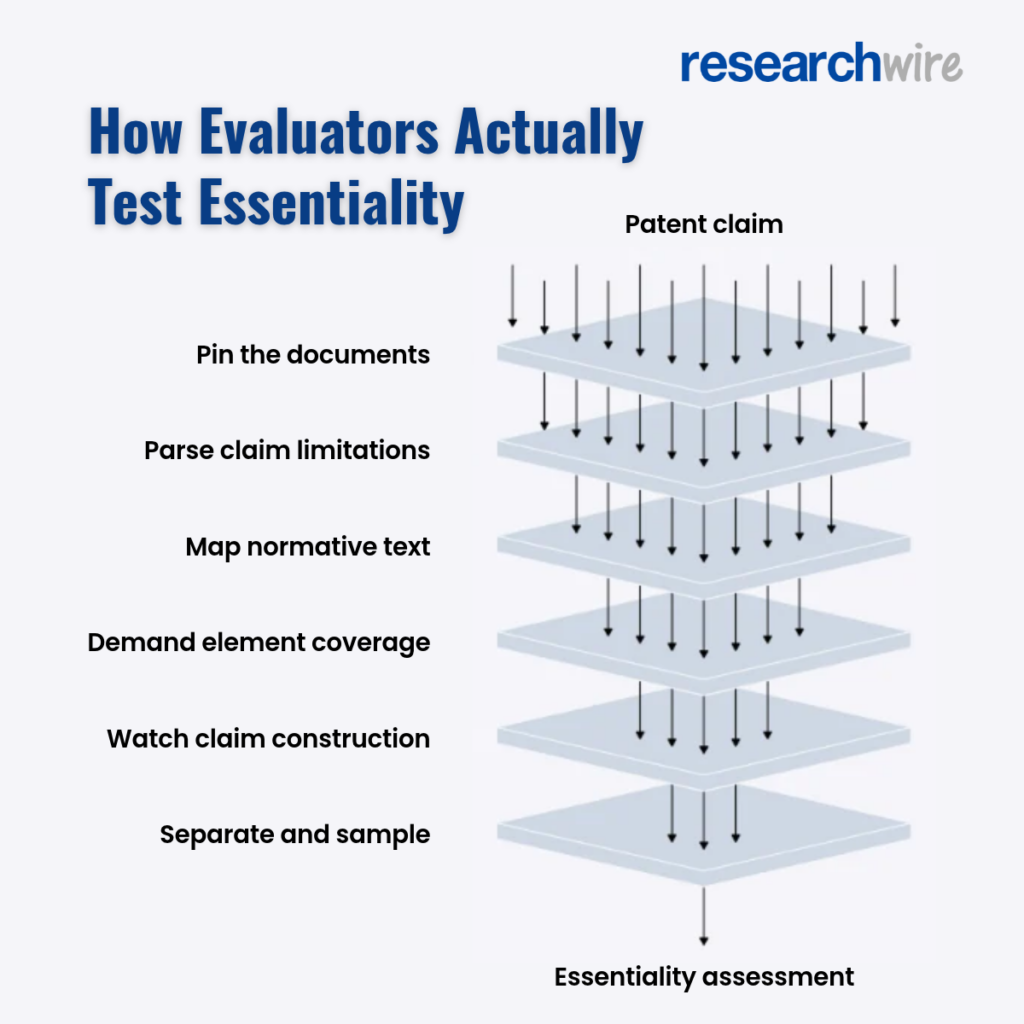 Demand element-by-element coverage: Every limitation must find a counterpart. Partial overlap, shared vocabulary, or a high-level functional similarity is not enough. If the claim requires a specific sequence, a particular message field, or a timing relationship, the chart should quote the clause that imposes that sequence, field, or timing.
- Watch claim construction: Evaluators read the claim in light of the specification and the prosecution history, but they should not import limitations that are not in the claim, nor stretch a term beyond what a skilled reader of the standard would accept. Ambiguous bridging language (“corresponds to,” “similar to”) is a warning sign. Charts used in licensing or litigation should state the construction they rely on.
- Separate essentiality from infringement and validity: Essentiality asks whether practicing the standard necessarily practices the claim. Infringement asks whether a particular product does so, including through the parts of the standard it actually implements. Validity asks whether the claim should have been granted at all. A clean essentiality chart does not prove the patent is valid, and a validity problem does not by itself prove the claim fails to read on the standard. Courts and negotiators treat these as related but distinct questions. In some forums, including patent suits in India, plaintiffs are expected to put claim-to-standard charts on the record rather than rely on a declaration alone.
- Use sampling with care: Portfolios can contain thousands of declared families. Parties often chart a sample and extrapolate an essentiality rate for valuation or FRAND discussions. The sample only supports that inference if it is representative across technologies, claim types, and declaration years, and if the charts are prepared under a consistent protocol. Patent pools sometimes add a further filter: independent essentiality review before a patent is admitted to a licensed list. That review is stronger evidence than a self-declaration, but it is still an opinion about specific claims and specific specification versions.
Where charts go wrong
Several recurring errors make charts unreliable:
- Mapping to informative or optional text while labeling the patent essential.
- Citing a different release from the one named in the declaration.
- Treating keyword overlap as correspondence, without showing that the claim’s structural or functional limits are required.
- Ignoring means-plus-function or software-implemented steps that need a concrete algorithmic hook in the standard.
- Charting only the patentee’s preferred embodiment instead of the claim as written.
- Failing to disclose assumptions, so a later reader cannot tell what was construed and what was quoted.
A strong chart is auditable. Someone who did not write it should be able to open the patent and the specification and agree, limitation by limitation, or mark a clear disagreement.
Why the work is hard to scale
Specifications for a single generation of cellular technology run to many thousands of pages across dozens of documents and multiple releases. Claims are dense, and the same technical idea may be described in different words in the patent and in the standard. Manual charting by a standards engineer and a patent attorney remains the gold standard for a patent that will be asserted or used as a comparable, but it is too slow and too expensive to apply blindly to every declared asset. That is why licensing teams increasingly separate screening from confirmation: a first pass to find candidate claim–clause pairings, then expert charts on the patents that matter for a negotiation, a pool submission, or a case.
Putting the evaluation into a working workflow
Essentiality is not a keyword match and not a self-declaration. It is a documented judgment: the right patent and the right specification version, claims split into limitations, each limitation tied to mandatory text, constructions stated, and the result reviewable by counsel. Done poorly, a chart inflates a portfolio or invites a challenge. Done well, it is the evidence file behind a license, a pool submission, or a case.
That is the work Researchwire is built to do. Researchwire is an IP research and analytics firm that supports legal and R&D teams with SEP mining and essentiality evaluation, evidence-of-use and claim-chart preparation, and licensing-feasibility studies across large, declared portfolios. Analysts map claims to the normative clauses of the relevant standard, record what is mandatory versus optional, and deliver charts that counsel can test rather than take on trust. For SEP programs, that human, specification-level review is still what decides whether a declared patent is essential.