In 2023 alone, over 10 million electric vehicles (EVs) were sold globally, marking a 55% increase from the previous year. As the number of electric vehicles on the road grows, the demand for more efficient and accessible charging solutions intensifies. Now, imagine a world where EVs never need to stop for a charge where they can continuously power up while driving, eliminating the need for frequent charging stops. This is the vision behind wireless charging roads, a revolutionary technology that could reshape the future of transportation and accelerate the adoption of electric vehicles (EVs).
Wireless charging roads promise to eliminate one of the key barriers to EV adoption charging time by powering vehicles while they are on the move. This technology, currently being tested in various parts of the world, could transform highways into dynamic charging zones, creating a seamless driving experience for electric vehicle owners. But how does this technology work, and what are the implications for the future of EV infrastructure?
The Science Behind Wireless Charging Roads
Wireless charging for electric vehicles is based on inductive charging, a technology that has been in use for devices like smartphones and electric toothbrushes for years. In this system, an electromagnetic field transfers energy between two coils: one on the vehicle and one embedded in the road. When the vehicle passes over the road, the roadside coil emits an electromagnetic field that induces a current in the vehicle’s receiver coil, thus charging the battery while the car is in motion.
The key component of wireless charging roads is the integration of power transfer systems into the infrastructure of highways and streets. This requires a reliable, continuous power supply embedded in the road surface, which can be a challenge for urban planners and engineers. However, advancements in power electronics, efficient energy transfer, and roadway construction are steadily making this technology more feasible.
The charging system on the road can deliver power at up to 20 kW per lane, a sufficient amount for vehicles to maintain an electric range even during long-distance travel. This capability allows EVs to keep moving while recharging, unlike conventional charging stations that require vehicles to stop and plug in.
The Current State of Wireless Charging Roads: Studies and Trials
The concept of wireless charging roads isn’t just theoretical. In recent years, Researchers have conducted numerous pilot projects to test this technology.
A few of the most notable trials include:
-
Sweden’s “Electrified Road” Project:
- Sweden has been at the forefront of this technology, conducting tests in the city of Västerås. Their “eRoadArlanda” project involves a 2-kilometer stretch of road equipped with wireless charging infrastructure. The road uses a combination of overhead wires and inductive charging systems to supply power to electric vehicles, with the aim to extend this concept to highways across the country.
- The project is a joint collaboration between Scania, ABB, and Vattenfall, with ongoing tests involving electric trucks. The initiative has shown positive results, with vehicles achieving efficiency gains of up to 85% in energy transfer during dynamic charging.
-
South Korea’s Wireless Charging Roads:
- South Korea is also embracing wireless charging technology. In Gumi City, researchers have developed a smart highway with embedded charging lanes designed for inductive power transfer (IPT). This test road provides energy to electric vehicles while they are driving, enabling continuous power supply without the need to stop and charge. The current phase of this project is focused on increasing the efficiency and sustainability of the technology.
-
France’s “Urban Charging” Initiative:
- France has experimented with dynamic wireless charging on a 100-meter stretch of road in the city of Satory. Here, electric buses are being tested to use inductive charging systems as they move, with a strong focus on improving the charging efficiency in high-traffic urban areas. The aim is to create a reliable network of charging roads in major cities, including Paris and Lyon.
-
United States and the UK:
- Both countries are exploring wireless charging road systems as part of their broader goals to reduce carbon emissions and encourage EV adoption. California has explored concepts like “charging while driving” on highways, and UK-based projects like “Urban Electric” have tested wireless EV charging with plans for wider rollouts. These countries are studying potential integration with smart grids to optimize energy usage in real-time.
Market Potential: A Look at Industry Growth and Companies Involved
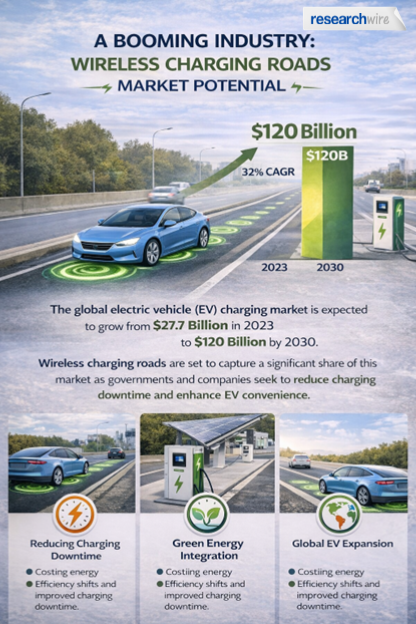
The wireless charging road market is part of the broader EV infrastructure market, which is projected to grow substantially in the coming years. According to Market Research Future, the global electric vehicle charging market is expected to reach a valuation of USD 120 billion by 2030, growing at a compound annual growth rate (CAGR) of 32%. The wireless charging segment, while still niche, will likely capture a significant share of this growth.
Several companies are leading the charge in developing and deploying wireless charging technology, including:
-
- Qualcomm:
- Qualcomm has been at the forefront of the wireless charging movement with its Halo The company has collaborated with various automotive companies to develop the wireless charging infrastructure for road systems. Qualcomm’s Halo system can provide up to 20 kW of charging power and is compatible with a range of electric vehicles.
- WiTricity:
- WiTricity is a leading innovator in wireless power transfer technology and develops dynamic wireless charging systems. Several countries are testing wireless charging technology. These efforts focus on making the system scalable for large-scale deployment.
- BMW:
- BMW has partnered with WiTricity to develop an inductive charging system for its electric vehicles, as part of its push to integrate wireless charging solutions into its electric vehicle lineup.
- Volvo:
- Volvo has also explored inductive charging technology by partnering with Piëch Automotive. Engineers are developing dynamic wireless charging for future EV systems.
- Qualcomm:
Challenges and Consequences of Wireless Charging Roads
Despite its potential, wireless charging roads face several challenges that need addressing:
- Cost of Implementation: The cost of embedding wireless charging technology into roads is high, with estimates ranging from USD 1 million to USD 3 million per kilometer of road, depending on the type of system deployed. Governments and private investors must weigh these costs against long-term environmental and economic benefits.
- Infrastructure Compatibility: Integrating wireless charging systems with existing road infrastructure is a significant challenge. It requires substantial investment in road upgrades, along with ongoing maintenance and monitoring of the systems to ensure they function properly over time.
- Energy Efficiency: Although wireless charging technology has made significant strides, it still needs to reach higher levels of energy efficiency. Current systems can charge vehicles at 85-90% efficiency, but there is still work to be done to ensure the technology is competitive with traditional plug-in charging.
- Regulatory and Standardization Issues: To make wireless charging a widespread solution, standardization of the technology is essential. Without universal standards for road infrastructure and vehicle compatibility, the technology will struggle to scale globally.
How Researchwire Can Contribute
At Researchwire, we offer market intelligence, competitive analysis, and research services that can help businesses navigate the emerging market of wireless charging roads. By providing in-depth industry reports, tracking patent filings, and evaluating technological trends, we empower stakeholders in the EV and infrastructure sectors to make data-driven decisions.
Our expertise in technology assessments and regulatory landscapes helps companies understand the challenges and opportunities within this innovative sector. Whether you are looking for insights into investment opportunities, market forecasts, or competitive landscapes, Researchwire can provide tailored solutions to guide your business strategies.
By leveraging Researchwire’s platform, organizations can stay ahead of trends, optimize their positioning in the wireless charging infrastructure market, and drive innovation in electric vehicle charging technologies.